A Word About Diastasis
Diastasis is of Greek origin (διάστασις) and means ‘separation’. The Latin derived word is ‘divarication’.
In this context, it describes a situation where the two vertical muscles on the front of the abdomen separate down the middle. The thin line, or membrane between them stretches, but there is no hole. This is not a hernia.
This is often seen in women in the post-pregnancy period. The smaller ones will not cause any problems and worsen but often women who have had a difficult child birth or ‘large’ babies may have a greater degree of muscle separation.
How do I know if I have Diastasis/Divarication?
Typically everything looks normal when you are standing, maybe a bit of a bulge or prominence, but when you sit up or get up from a lying position you see a vertical ridge running from the breast bone to the navel. It can be quite prominent and sometimes very alarming, but a Diastasis or Divarication is not a hernia.

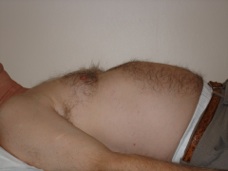
Problem
Some call it a ‘ventral hernia’ – this worries and confuses patients and makes them think they need an operation. A prime example of the need for an expert diagnosis and sound advice.
So if it is not a hernia but a Diastasis/Divarication, our advice is to leave it alone unless it is quite large and causing problems such as discomfort (rare) and back pain (quite common with large ones). Often the appearance of the abdomen, especially if associated with excessively loose skin, can cause considerable psychological and social distress, in which case, a repair could be considered.
Repair
Usually done by laparoscopic surgery to avoid large incisions. The muscles are approximated together and a mesh is sandwiched between the muscle layers (technique similar to incisional hernia).